REPORT: Agile Leaders Confront the AI Skills Gap Learn more

Digital Thread Software: How PLM Connects Your Entire Product Lifecycle

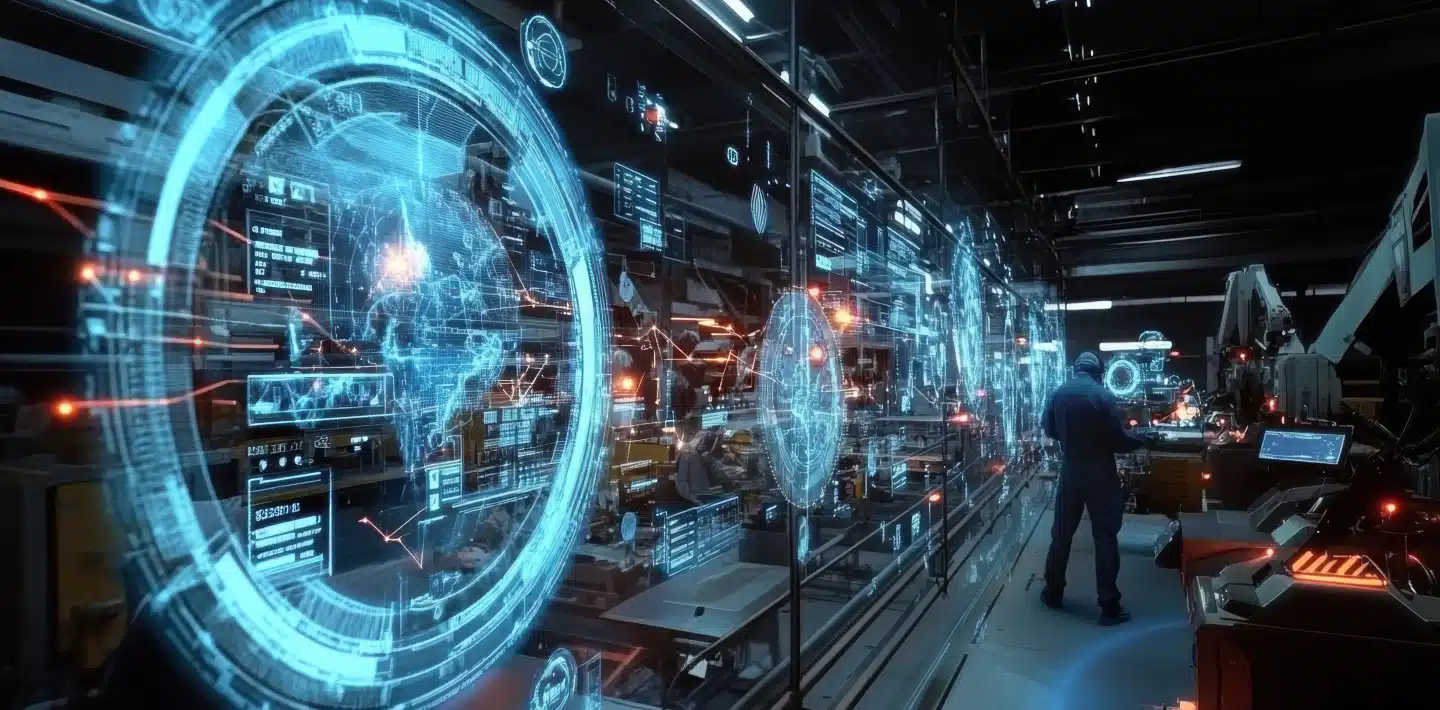
A high-tech control room with transparent screens displaying digital globes, PLM data, and graphics, while a person works at a station surrounded by advanced equipment and the Digital Thread in dim lighting.

What is a digital thread in manufacturing?

Digital thread software is a system that links product data — from initial design through engineering, manufacturing, service, and end-of-life — into a single, continuous, traceable flow. Rather than storing data in disconnected applications, a digital thread connects CAD systems, PDM/PLM platforms, ERP, CRM, and IoT data into a coherent product record. For manufacturers, it means any team member can trace a field complaint back to the original design decision, or identify a quality issue before it reaches production.

Why disconnected data is a manufacturing problem

Most manufacturers manage product-relevant data across several disconnected systems. Mechanical designs live in a CAD tool. BOMs are maintained in spreadsheets or ERP. Service records are in CRM. Quality data is in a separate quality management system. Supplier communications happen over email.
Each of those systems holds a piece of the product record. None of them are connected. When a customer raises a complaint about a field failure, tracing it back through design history, part revisions, and supplier changes requires manual lookup across all of them — if the data has even been retained in a retrievable form.
The result is a manufacturing organisation that reacts to problems rather than anticipating them. Recurring defects persist because the connection between field data and engineering decisions is never made. Changes that should have been preventive become corrective. Time-to-resolution is measured in weeks, not hours.
This is the problem the digital thread solves. Not by adding another system, but by connecting the systems that already exist into a coherent, traceable product record.

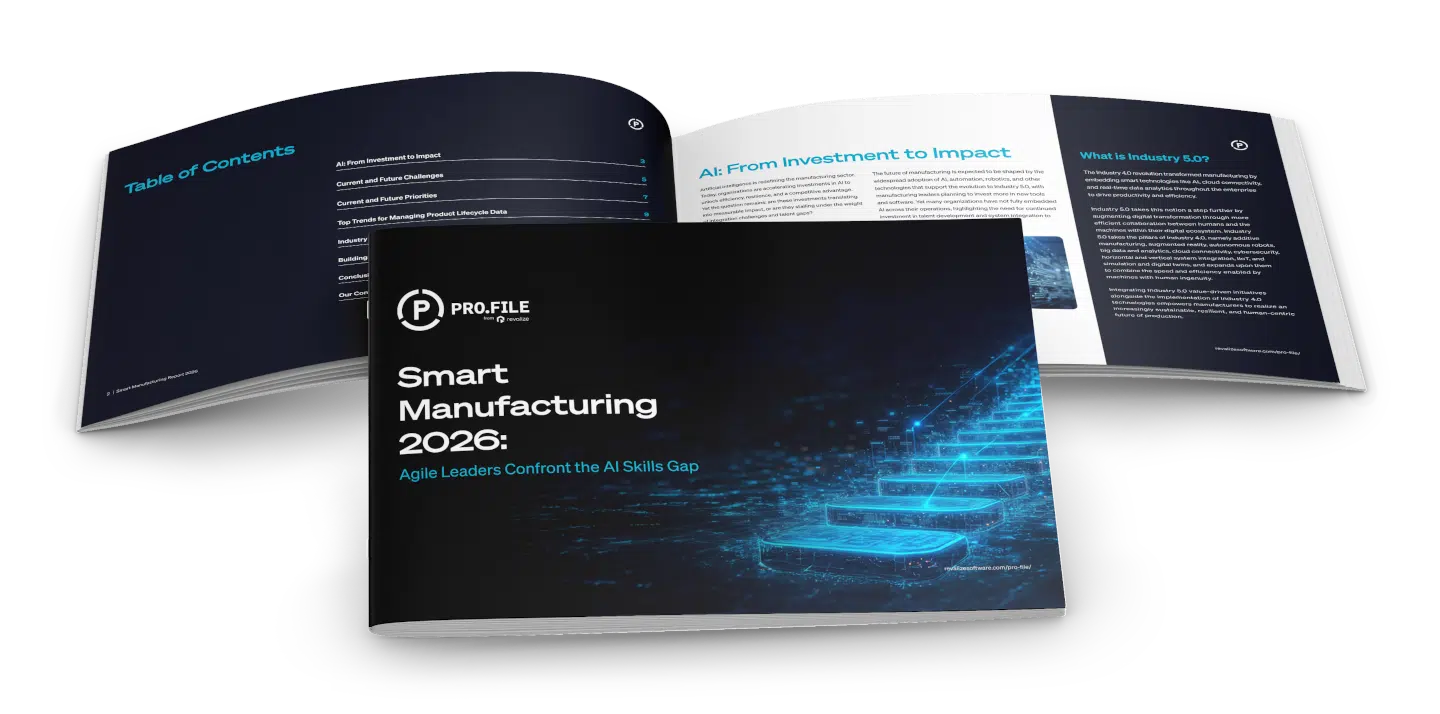
Smart Manufacturing Report 2026

Get your copy of the Smart Manufacturing 2026 report to learn how manufacturing leaders are confronting the AI skills gap, integration complexities, and other operational challenges. Download today!

Two open booklets, the front displaying Smart Manufacturing 2026: Agile Leaders Confront the AI Skills Gap, with digital-themed blue graphics on the cover.

How PLM software builds the digital thread

A PLM system is the structural foundation of the digital thread. It does not replace CAD, ERP, or CRM — it connects them, holding the product record that gives every piece of data its context.
In practice, this means:
Each of these connections is a segment of the digital thread. Together they form the continuous data flow that runs from the first design sketch to the last service call.

What a connected digital thread makes possible

For a mid-market manufacturer running PLM as its digital thread platform, the operational impact is concrete:
These outcomes are not dependent on a full digital transformation programme. They are achievable with a focused PDM/PLM implementation that connects the systems manufacturers already have.

How PRO.FILE builds your digital thread

PRO.FILE is the PDM/PLM platform built for mid-market discrete manufacturers who need to establish a digital thread without enterprise complexity or cost. As the central product data repository, PRO.FILE connects the key systems that form the thread:
The implementation methodology is structured to deliver a working digital thread foundation in 8 to 12 weeks. Configuration is handled through EASY.CON, PRO.FILE’s no-code configuration tool, without custom development. PLM modules — extending the thread into quality management, service, and full lifecycle processes — are added incrementally as the organisation’s processes mature.

To learn more about how PRO.FILE builds a digital thread for discrete manufacturers, visit our digital thread platform page or download our ebook, From Data Chaos to Digital Clarity with the Digital Thread.

FAQ

Digital thread software is a system that creates a continuous, traceable link between all product data generated across the product lifecycle — from design and engineering through manufacturing, service, and end-of-life. It connects data from CAD systems, PDM/PLM platforms, ERP, CRM, and IoT sources into a single coherent product record, eliminating the data silos that typically separate engineering, operations, and service teams.
A digital thread is the connected data flow across the product lifecycle. A digital twin is a virtual model of a specific product or asset that uses live operational data. The digital thread is what enables the digital twin: the thread provides the data infrastructure that links design, manufacturing, and operational data, and the twin uses that connected data to model and simulate a physical product in real time. You need the thread to build a meaningful twin.
A manufacturer builds a piece of industrial machinery. During field operation, a customer reports a vibration issue. With a digital thread in place, the service team logs the complaint in the CRM; the PLM system traces the affected component to its specific part revision and the engineering change order that last modified it; the engineering team reviews the design decision and initiates a corrective change. Without the digital thread, that traceability chain requires manual lookup across disconnected systems — if it is possible at all.
PLM software creates the digital thread by acting as the central repository for product data and connecting it to adjacent systems. It maintains version-controlled CAD data, links engineering BOMs to manufacturing BOMs, manages engineering change workflows, and integrates with ERP for BOM transfer and CRM for complaint traceability. The PLM system does not hold all the data itself — it holds the structured product record and the integration layer that connects data from other systems into that record.
In a PLM context, the digital thread is the connected, traceable flow of product information that a PLM system maintains and enables. It encompasses the product’s design data, change history, manufacturing BOM, quality records, and service history — all linked to a consistent product identity. PRO.FILE builds this thread by connecting CAD data, engineering change processes, BOM management, and ERP/CRM integrations through a single platform.

PRO.FILE's Blogs

Two open booklets, the front displaying Smart Manufacturing 2026: Agile Leaders Confront the AI Skills Gap, with digital-themed blue graphics on the cover.

Smart Manufacturing Report 2026

Get your copy of the Smart Manufacturing 2026 report to learn how manufacturing leaders are confronting the AI skills gap, integration complexities, and other operational challenges. Download today!