REPORT: Agile Leaders Confront the AI Skills Gap Learn more

PDM vs PLM: What Is the Difference and Which Does Your Team Need?

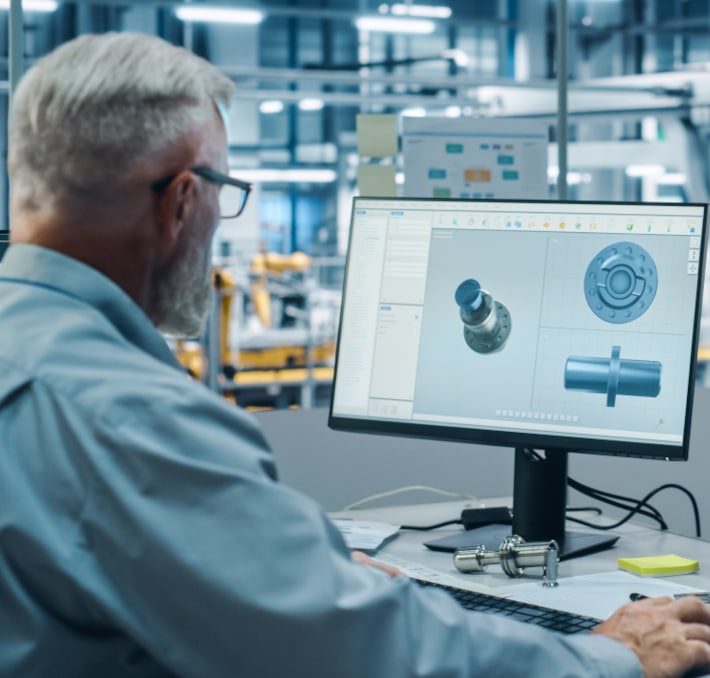
A large, modern factory floor with people working among machinery and digital data overlays highlighting advanced manufacturing technology, where PDM vs PLM solutions drive efficient production and seamless information flow.
PDM (product data management) and PLM (product lifecycle management) are related but distinct disciplines. PDM controls the product data created during engineering and design — CAD files, bills of materials, revision history, and engineering change processes. PLM extends that control across the full product lifecycle, from concept through manufacturing, service, and end-of-life. For most mid-market manufacturers, PDM is the right starting point.

What PDM software does

PDM software gives engineering teams a single, controlled repository for all product-related data. Engineers check CAD files in and out with full version history. BOMs are linked directly to CAD models and update when designs change. Engineering change requests, orders, and notices move through structured, trackable workflows instead of email. Access permissions protect IP and ensure only authorized users can release or modify designs.
The scope of PDM is deliberate: it solves the problems that live in the engineering department. That focus is why PDM deployments are faster and less expensive than full PLM projects, and why PDM is the natural first step for manufacturers replacing shared drives or deprecated legacy systems.

Smart Manufacturing Report 2026

Get your copy of the Smart Manufacturing 2026 report to learn how manufacturing leaders are confronting the AI skills gap, integration complexities, and other operational challenges. Download today!

Two open booklets, the front displaying Smart Manufacturing 2026: Agile Leaders Confront the AI Skills Gap, with digital-themed blue graphics on the cover.

What PLM software does

PLM extends product data management beyond the engineering team. Where PDM manages the data that engineers create, PLM manages how that data flows through the rest of the organization — into program management, quality assurance, regulatory compliance, supplier collaboration, and service and maintenance.
A PLM system connects engineering BOMs to manufacturing BOMs, tracks configuration changes across product generations, manages requirements and test results, and gives program managers visibility across multiple development programs simultaneously. The scope is wider, the stakeholder set is larger, and the implementation footprint is significantly greater than PDM.

PDM vs PLM: side-by-side comparison

PDM PLM
Scope Engineering data during design and development Full product lifecycle — concept through end-of-life
Core function CAD file management, version control, BOM management, engineering change workflows PDM capabilities + program management, requirements, quality, service, supplier collaboration
Primary users Design engineers, engineering managers, CAD managers, IT Engineering, operations, quality, supply chain, program management, executive
Typical company fit Mid-market manufacturers, 50–1,000 employees, product complexity is the primary driver Larger manufacturers or those with complex multi-program, multi-site, or regulated product environments
Implementation complexity Lower — focused scope, faster deployment (8–12 weeks typical) Higher — broader scope, longer deployment (12–24 months for enterprise PLM)
Cost model Lower TCO — focused licensing, on-premise option keeps infrastructure costs predictable Higher TCO — broader licensing, enterprise deployment, ongoing customization costs
Starting point? Yes — PDM is the natural first step for manufacturers moving off shared drives Usually built on top of an existing PDM foundation

When PDM is the right starting point

For most manufacturers with 50 to 1,000 employees, PDM is the correct first investment. The indicators are straightforward:
Any one of these is a strong signal that PDM is overdue. You do not need PLM to fix these problems — and investing in PLM before the PDM foundation is solid typically makes both more expensive and less effective.

When to expand from PDM to PLM

PDM becomes insufficient when the product data problems extend beyond the engineering team. The signals for PLM readiness are:
PRO.FILE is designed to support this progression without requiring a full reimplementation. The PDM foundation — CAD data management, BOM management, engineering change control — stays in place. PLM capabilities are added as modules on top of it.

How PRO.FILE supports both PDM and PLM

PRO.FILE is purpose-built for mid-market discrete manufacturers who need PDM now and PLM later — without paying for enterprise complexity upfront. The PDM layer covers CAD file management for all major platforms (SolidWorks, Inventor, Creo, CATIA, NX), structured BOM management with the xBOM editor, engineering change management with ECR/ECO/ECN workflows, and direct ERP integration via the Revalize Integration Hub.
PLM capabilities — including digital thread visibility, document management, and extended lifecycle modules — are available as the organization’s processes mature. The implementation methodology is structured to deliver value in 8 to 12 weeks for the PDM foundation, with PLM scope added incrementally rather than as a single large-scale deployment.

FAQ

PDM (product data management) manages the data created during the engineering and design phase — CAD files, BOMs, revision history, and engineering change workflows. PLM (product lifecycle management) is a broader discipline that extends data and process management across the full product lifecycle, from initial concept through manufacturing, service, and end-of-life. PDM is typically the foundation on which PLM capabilities are built.
Most mid-market manufacturers should start with PDM. If your primary pain is managing CAD files, controlling engineering changes, and maintaining accurate BOMs, PDM solves that directly. You need PLM when those problems extend beyond engineering — into program management, quality processes, regulatory compliance across multiple teams, or supplier lifecycle collaboration. PRO.FILE lets you start with PDM and expand to PLM as your needs grow, without re-implementing.
Yes, with the right platform. PRO.FILE is built as both a PDM and PLM solution. You can deploy the PDM capabilities first — CAD data management, BOM management, engineering change control — and enable PLM modules as your processes mature. This avoids the cost and disruption of replacing one system with another.
Yes. PDM is a subset of PLM. All PLM systems include PDM capabilities. The distinction is scope: a standalone PDM system covers the engineering data layer; a PLM system extends that coverage into the broader product lifecycle. Some manufacturers choose dedicated PDM software for its focused fit and lower cost, and add PLM capabilities later.

SolidWorks PDM (formerly EPDM) is a file-based vault system designed specifically for SolidWorks users. It provides version control and basic BOM management within the SolidWorks environment. A full PDM/PLM system like PRO.FILE manages CAD data from multiple CAD platforms — SolidWorks, Inventor, Creo, CATIA, NX — in a single repository, with full engineering change workflows and ERP integration.

A focused PDM implementation typically takes 8 to 12 weeks. A full enterprise PLM deployment typically takes 12 to 24 months and requires significant internal IT and process resources. PRO.FILE’s structured implementation methodology — built around configuration rather than custom development — targets 8 to 12 weeks for the PDM foundation, with PLM modules added incrementally. 

PRO.FILE's Blogs

Two open booklets, the front displaying Smart Manufacturing 2026: Agile Leaders Confront the AI Skills Gap, with digital-themed blue graphics on the cover.

Smart Manufacturing Report 2026

Get your copy of the Smart Manufacturing 2026 report to learn how manufacturing leaders are confronting the AI skills gap, integration complexities, and other operational challenges. Download today!